
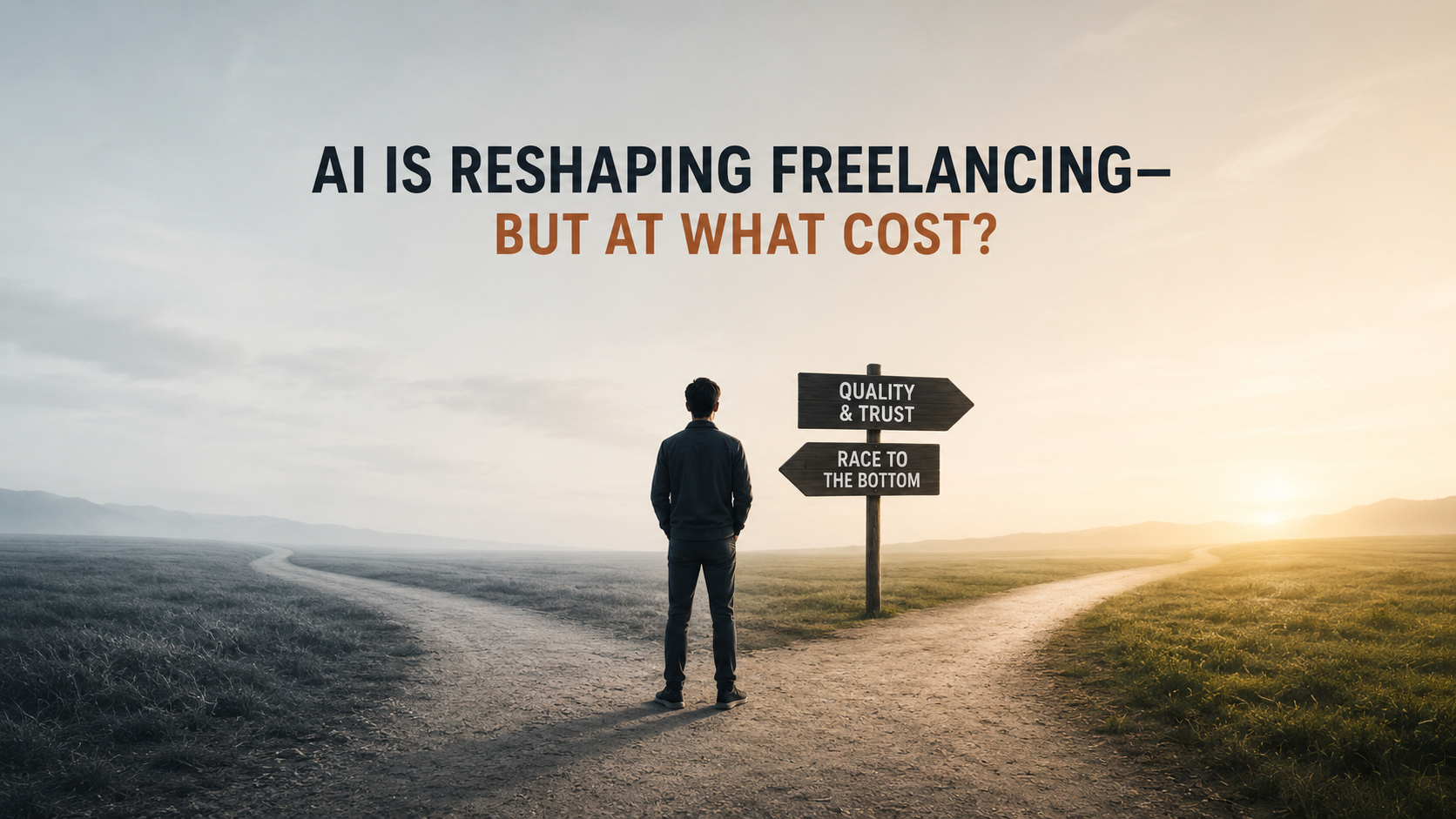
AI Is Reshaping Freelancing, But at What Cost?
Artificial intelligence has brought undeniable advantages to our industry. It accelerates workflows, lowers barriers to entry, and unlocks creativity at an unprecedented scale. While debates about its long-term implications continue, its impact is already transforming how work is approached in practice.
Nowhere is this shift more visible than on freelance platforms.
We’re seeing a growing trend of individuals with little or no professional experience taking on increasingly complex, multidisciplinary projects, often at the lowest possible rates. On the surface, this may appear to be healthy competition. In reality, it risks creating a race to the bottom, undermining both quality and trust across the ecosystem.
At the same time, client behavior is evolving.
Rather than investing the time needed to understand and define their requirements, many clients now use AI to expand a one-sentence idea into a detailed project brief and then post it directly as a job.
This is where problems begin.
Understanding a project is a skill in itself.
When that critical step is skipped, everything that follows is built on unstable foundations: unclear expectations, unrealistic scopes, poor communication, and, ultimately, frustration on both sides.
The consequences are becoming increasingly apparent:
- More failed projects
- More dissatisfied clients and freelancers
- A gradual erosion of the perceived value of professional expertise
AI is a powerful tool, but it should enhance expertise, not replace the thinking that makes expertise valuable in the first place.
Freelance platforms also have a role to play. As AI continues to reshape the marketplace, there is a growing responsibility to introduce mechanisms that encourage better project definition, fairer competition, and stronger alignment between required skills and actual capabilities.
If we want a sustainable freelance ecosystem, both clients and freelancers must recognize a simple truth:
Good work still begins with clear thinking, proper understanding, and real experience.
Otherwise, we risk turning opportunity into noise.