Ali Namin

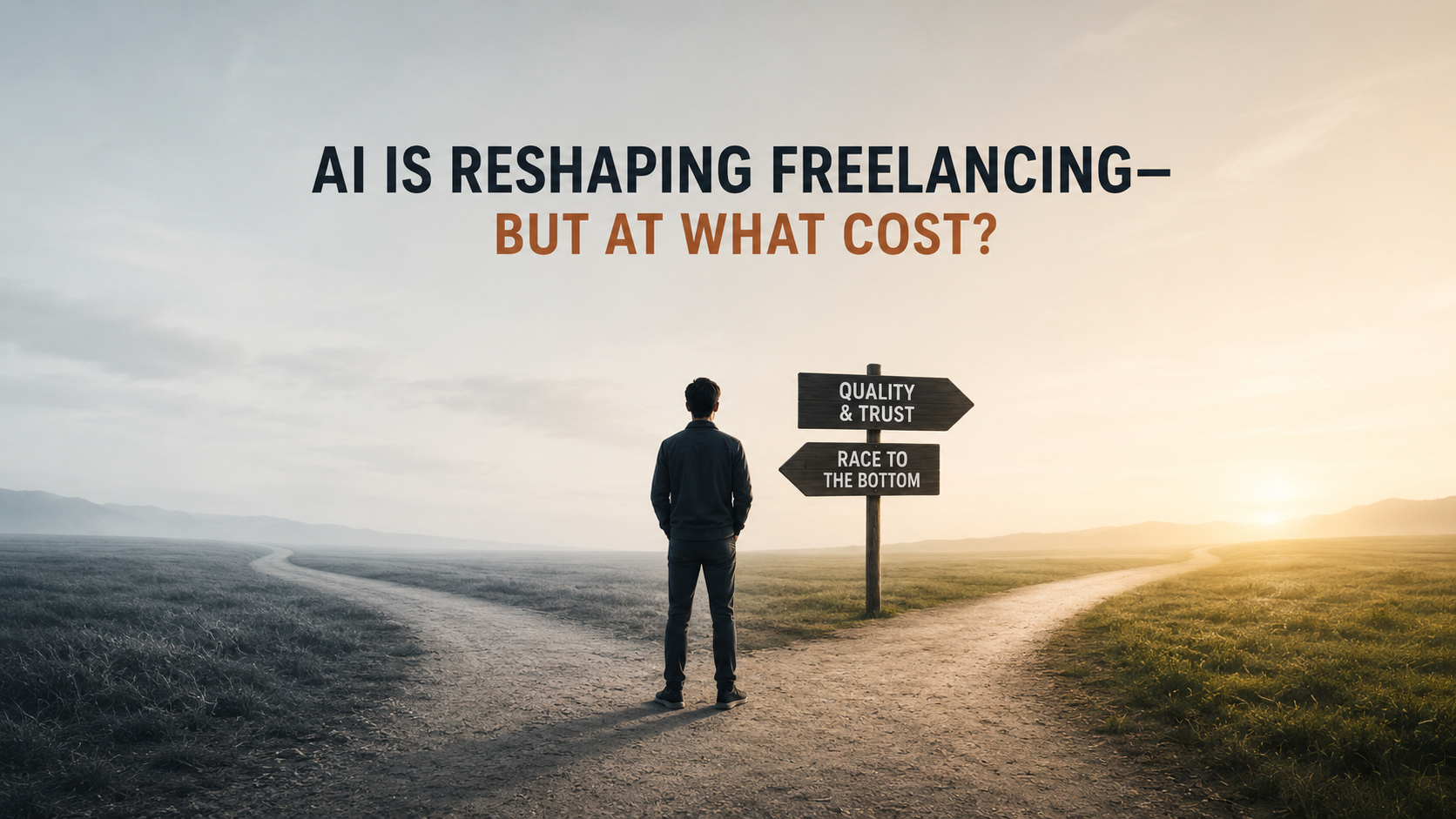
AI Is Reshaping Freelancing, But at What Cost?

Artificial intelligence has brought undeniable advantages to our industry. It accelerates workflows, lowers barriers to entry, and unlocks creativity at an unprecedented scale. While debates about its long-term implications continue, its impact is already transforming how work is approached in practice.

Nowhere is this shift more visible than on freelance platforms.

We’re seeing a growing trend of individuals with little or no professional experience taking on increasingly complex, multidisciplinary projects, often at the lowest possible rates. On the surface, this may appear to be healthy competition. In reality, it risks creating a race to the bottom, undermining both quality and trust across the ecosystem.

At the same time, client behavior is evolving.

Rather than investing the time needed to understand and define their requirements, many clients now use AI to expand a one-sentence idea into a detailed project brief and then post it directly as a job.

This is where problems begin.

Understanding a project is a skill in itself.

When that critical step is skipped, everything that follows is built on unstable foundations: unclear expectations, unrealistic scopes, poor communication, and, ultimately, frustration on both sides.

The consequences are becoming increasingly apparent:

  • More failed projects
  • More dissatisfied clients and freelancers
  • A gradual erosion of the perceived value of professional expertise

AI is a powerful tool, but it should enhance expertise, not replace the thinking that makes expertise valuable in the first place.

Freelance platforms also have a role to play. As AI continues to reshape the marketplace, there is a growing responsibility to introduce mechanisms that encourage better project definition, fairer competition, and stronger alignment between required skills and actual capabilities.

If we want a sustainable freelance ecosystem, both clients and freelancers must recognize a simple truth:

Good work still begins with clear thinking, proper understanding, and real experience.

Otherwise, we risk turning opportunity into noise.

From IT Department to Independence (2011–2022)

When I graduated from university with a degree in software engineering, I was eager to begin my career. Like many graduates, I imagined myself solving complex problems, building meaningful products, and making a contribution through technology.

My journey began as an intern in the IT department of a large organization. It was my first exposure to professional work, and I approached it with energy and curiosity. After one year of internship, I was offered a full-time role as a junior IT expert. I embraced it with enthusiasm; every task was a chance to learn. Over time, however, I realized that the role didn’t fully align with the long-term career path I envisioned.

Even so, those years became a valuable foundation. I gained experience working within teams, learned the importance of clear communication, and developed resilience under pressure. I built patience, problem-solving abilities, and the interpersonal skills needed to navigate different workplace dynamics. These lessons have stayed with me and continue to shape how I approach my work today.

After nearly a decade, I started reflecting more seriously on my future. I asked myself whether continuing on the same path would bring me closer to my goals. I carefully evaluated the options ahead: I could move into another organization, or I could take a different route. Ultimately, I chose independence — not because it was the easiest path, but because it gave me the one thing I valued most at that stage: time. Time to sharpen my skills, explore new directions, and discover what truly aligns with my passion and vision.

One factor that gave me the confidence to take this step was preparation. Over the years, I had built a savings buffer that could cover about a year of living expenses. That safety net gave me peace of mind and allowed me to take a thoughtful, strategic risk.

When I eventually shared my decision to resign, my manager surprised me by promoting me to Chief of the IT group in an effort to change my mind. It was an honor and a recognition of my contributions, and it made the decision even more difficult. But after careful consideration, I realized that even with a new title, the direction remained the same. I wanted to grow in a way that only stepping out could provide.

So I followed through with my decision.

For me, this was not an ending but a new beginning. It marked the start of working independently, investing in my skills, and moving toward the future I had always envisioned.

A Note to Others on the Same Path

If you find yourself in a role that doesn’t align with your long-term vision, know that it’s okay to pause, reflect, and make a change. But be realistic about your situation; every person’s circumstances are different. In my case, I was married and had my wife’s support. I had also built savings to sustain me for at least a year, which gave me confidence to take the leap. Most importantly, I was decisive enough to embrace the risks and commit fully to the change.

Preparation, support, and self-awareness make all the difference. Sometimes the bravest move isn’t climbing higher on the same ladder, but choosing a different one altogether.